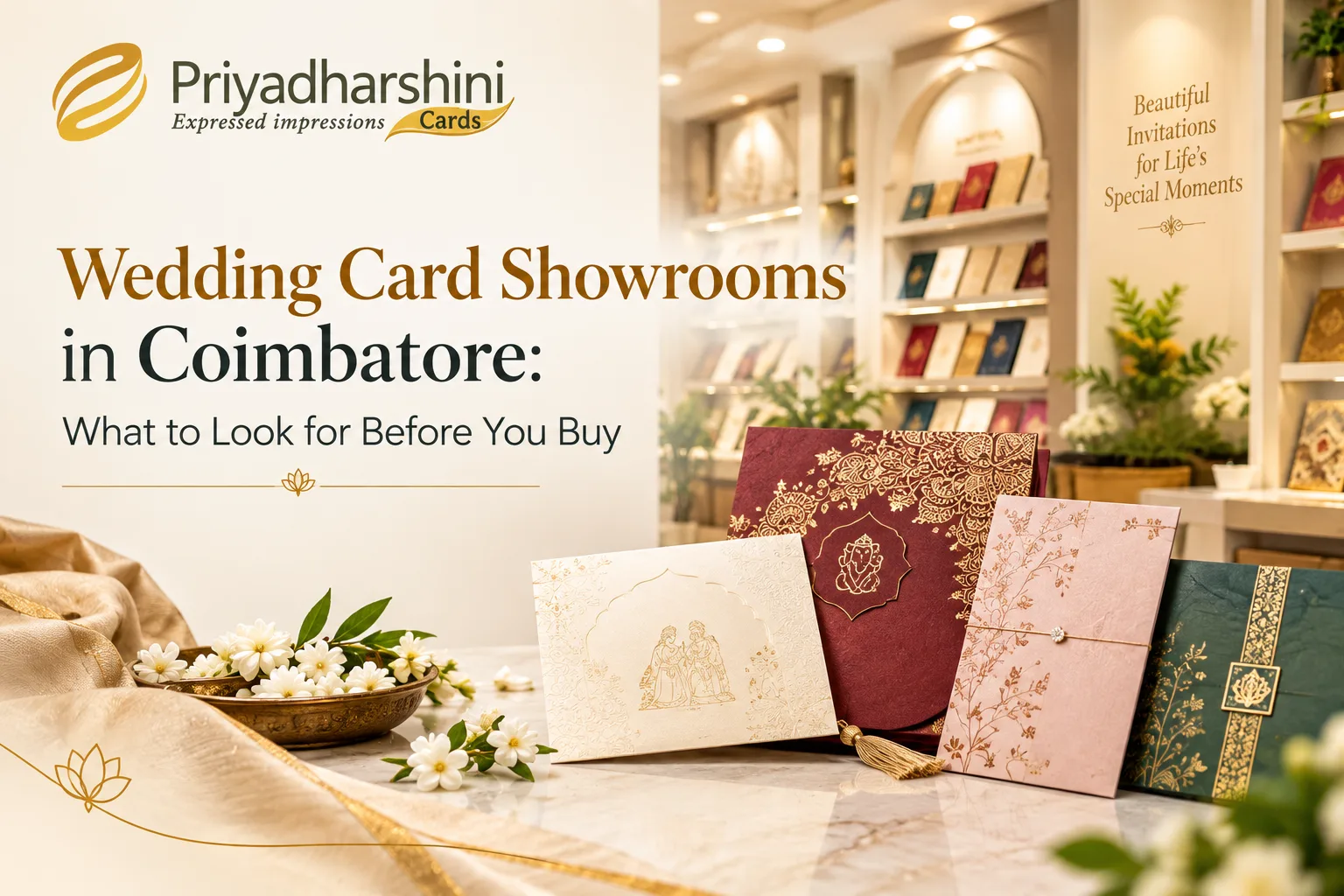
Choosing a wedding invitation is rarely as simple as picking the prettiest card in the pile. By the time most couples and families start comparing wedding card showrooms in Coimbatore, they're also weighing design, customization, wording accuracy, paper quality, quantity, budget, and how much time they realistically have before the wedding.
A card that looks beautiful but arrives with a spelling error, the wrong venue address, or a two-week delay causes far more stress than a plain design that's handled correctly. This guide walks through exactly what to check before you commit to a showroom or place your order.
Why Does Choosing the Right Wedding Card Showroom Matter?
The wedding invitation is usually the first physical object a guest associates with the wedding, so its accuracy, quality, and presentation quietly signal how the rest of the event has been planned.
It's worth keeping this in proportion — an invitation doesn't make or break a wedding. But it is often the very first impression guests receive, arriving weeks before the ceremony itself. A showroom that helps you get the details right the first time (correct names, accurate dates, clear venue information, appropriate design for the occasion) saves you from the more common problem: realizing an error only after cards have already been distributed to relatives.
10 Things to Look for Before Choosing a Wedding Card Showroom in Coimbatore
1. Variety of Wedding Invitation Designs
Short answer: Look for a showroom that offers more than one design language — traditional, contemporary, minimalist, and premium — rather than a single house style.
Weddings vary enormously even within the same community. Some families want a heavily traditional design with religious motifs and classical typography; others prefer a cleaner, more contemporary layout with minimal ornamentation. A showroom with genuine range lets you compare these side by side instead of settling for whatever a single printer happens to specialize in.
2. Customization Options
Short answer: Confirm exactly what can be changed — wording, names, colors, motifs, and card format — before you fall in love with a specific sample design.
Ask directly: can the base design's color be changed to match your wedding palette? Can a specific motif (a particular deity, a monogram, a family crest) be added? Can the format itself — single card, folded card, boxed invitation — be adjusted? Some showrooms treat samples as fixed templates with only text swapped in; others allow genuine design customization. Knowing which one you're dealing with avoids disappointment later.
3. Card Material and Finishing
Short answer: Ask to physically handle the paper stock and examine the finish — texture, weight, and print clarity — rather than judging from a photo or screen alone.
Material and finishing are difficult to evaluate from images. Paper weight, glossy versus matte finish, embossing depth, and foil quality all feel different in hand than they appear on a phone screen or in a catalog photo. This is one of the strongest arguments for visiting a physical showroom rather than ordering sight-unseen — you can inspect a real sample before committing to a large print run.
4. Wedding Card Design That Matches Your Celebration
Short answer: The invitation should reflect the actual tone of your wedding — formal or informal, large or intimate, traditional or modern — rather than being chosen in isolation from the rest of the event.
A heavily ornate, multi-page traditional card can feel mismatched for a small, informal ceremony, just as an ultra-minimalist card can feel understated for a large, elaborate multi-day wedding. It helps to think about your invitation as one part of a broader impression, alongside venue, family expectations, and the scale of the celebration, rather than a decision made purely on visual preference.
5. Religious and Cultural Requirements
Short answer: Check whether the showroom has genuine experience designing for your specific community's traditions, not just a generic catalog labeled by religion.
Hindu, Muslim, and Christian wedding invitations each carry their own conventions. Hindu invitations commonly open with an invocation, most often to Lord Ganesha — traditionally worshipped at the start of new undertakings and widely known as the remover of obstacles (Britannica) — alongside specific ritual references such as the baraat or the doli. Muslim wedding invitations for the Nikah and Walima ceremonies typically follow their own structure and phrasing conventions rooted in the marriage contract itself. Christian wedding invitations often favor a simpler, church-ceremony-appropriate format, sometimes including a scripture verse. A showroom that genuinely understands these distinctions — rather than simply reprinting a generic template with a different border — is worth prioritizing if these traditions matter to your family.
6. Clear Pricing and Budget Planning
Short answer: Ask what specifically drives the price of a card — paper type, finish, print method, and order quantity — so you can compare options on a like-for-like basis.
Wedding card pricing is rarely a single flat number; it typically depends on the combination of paper stock, printing method (offset vs. digital), special finishes (foil, embossing), and the total quantity ordered. Rather than asking for "the price," ask what changes the price, so you can make informed trade-offs — for example, choosing a simpler finish to fit more cards into your budget, or vice versa.
7. Quantity and Guest List Planning
Short answer: Estimate your quantity from your actual guest and family list first, then add a reasonable buffer for last-minute additions, errors, and keepsakes, rather than guessing a round number.
Indian weddings often involve distributing cards through extended family and community networks rather than a strict one-per-household mailing list, so quantity planning looks different than in a typical Western context. It generally helps to work from your actual list of families and individuals to be invited, confirm how the showroom handles reordering if you fall short, and build in some extra copies for last-minute additions or for keeping as a memento.
8. Proofreading and Invitation Wording
Short answer: Before giving final approval, carefully check the spelling of every name, the date, the day of the week, the venue address, and the timing — these are the most common and most costly errors.
It's worth reading the proof more than once, and ideally having a second family member check it independently — names and venue details are easy to miss when you've read the same text repeatedly. If you need help with the wording itself (appropriate phrasing, formal titles, or how to credit both families correctly), ask the showroom directly whether this kind of assistance is available before you start designing.
9. Order Timeline and Delivery Planning
Short answer: Build in enough time for design selection, customization, proofing, corrections, and final printing — rushing any one of these steps is where most invitation errors happen.
Every stage — choosing a design, requesting customization, reviewing a proof, making corrections, and finally printing — takes time, and rushing any single step increases the chance of an error slipping through. Ask the showroom directly how long their process typically takes from confirmed design to finished cards, and whether that estimate changes for a busy wedding season, so you can plan your order date with a realistic buffer.
10. Showroom Guidance and Customer Experience
Short answer: A showroom that offers practical guidance — not just a product catalog — based on your specific wedding's requirements tends to reduce decision fatigue and design mistakes.
Choosing an invitation from hundreds of options can be overwhelming, especially alongside everything else a wedding involves. Staff who can narrow choices based on your stated preferences, community, and budget — rather than simply pointing you to a catalog — make the process considerably less stressful.
Why Visit a Wedding Card Showroom in Coimbatore?
Seeing and handling actual card samples lets you evaluate material, size, and finish accurately, and discuss customization and wording in real time — something photos and product listings can't fully replace.
Ordering wedding cards online without seeing them in person carries a specific risk: colors render differently on different screens, paper weight and texture can't be felt, and print quality (particularly foil work or embossing) often looks better or worse in person than in a photo. Visiting a wedding card showroom in Coimbatore in person lets you compare multiple designs side by side, physically check paper stock, confirm the actual card size and format, and walk through wording and customization questions directly with someone who can answer them immediately rather than over email. For a purchase that's difficult to reverse once printed, that direct comparison is genuinely useful.
Exploring Wedding Invitation Cards at Priadharsini Cards
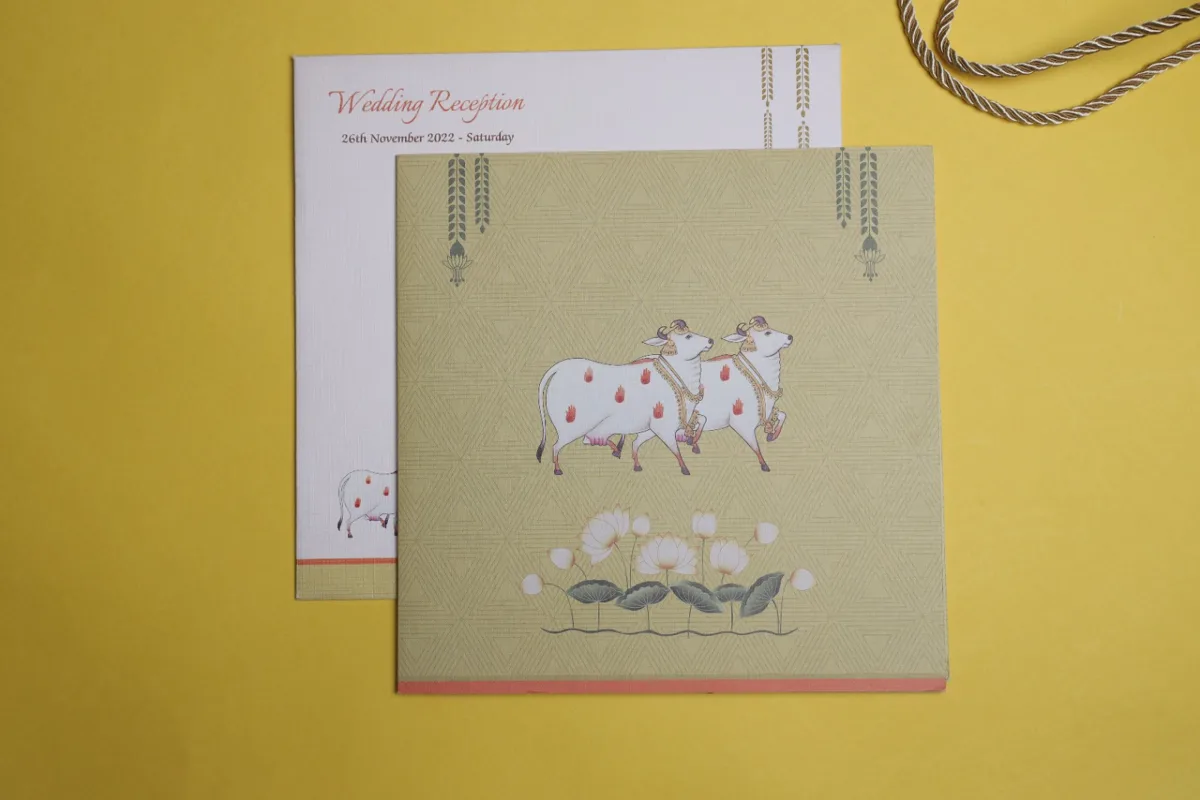
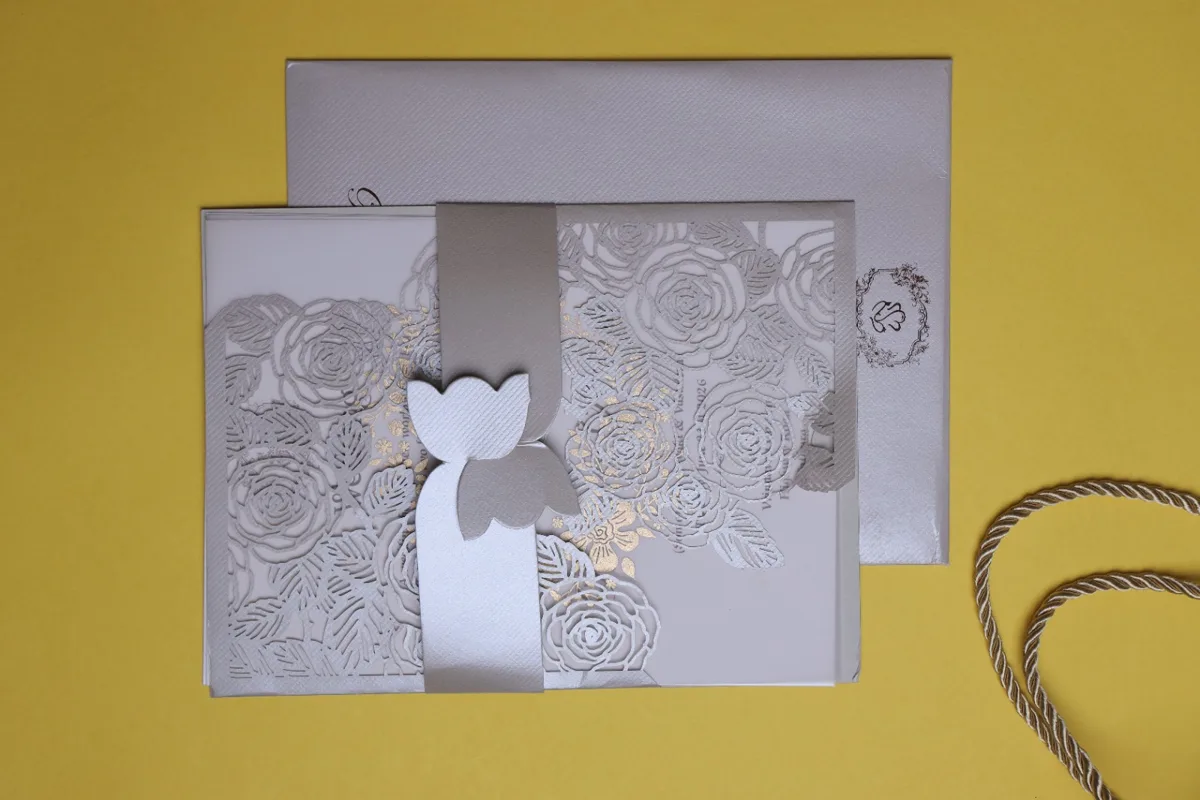
For readers exploring their options in Coimbatore, Priadharsini Cards operates a showroom offering wedding invitation cards across Hindu, Muslim, and Christian traditions, along with card types including box cards and embossed cards. Hindu wedding designs make up the largest part of the catalog and include traditional motifs such as Lord Ganesha, along with baraat, baraati, and doli-style artwork. The showroom is located on Kalidas Road, Ram Nagar, Coimbatore. Readers can browse the full wedding cards collection, explore Hindu invitation designs, Muslim invitation designs, or Christian invitation designs directly, or get in touch through the enquiry page with specific questions before visiting.
Quick Checklist Before Buying Wedding Invitation Cards
- Design style matches the tone of your wedding
- Customization options are clearly confirmed (wording, colors, motifs, format)
- Card material and finish have been physically inspected
- Religious/cultural requirements are correctly reflected
- Pricing structure and what drives cost are understood
- Quantity is based on your actual guest/family list, plus a buffer
- Every name, date, and venue detail has been proofread carefully
- Order timeline allows for proofing and corrections, not just printing
- Delivery or pickup arrangement is confirmed
- Final design has been approved in writing before mass printing begins
Frequently Asked Questions
What should I check before choosing a wedding card showroom?
Check the variety of designs available, whether genuine customization is offered, the actual card material and finish, pricing structure, and whether the showroom has real experience with your specific community's invitation traditions.
How early should I order wedding invitation cards?
Allow enough time for design selection, customization, proofing, corrections, and printing — the exact timeline varies by showroom and by how customized your design is, so it's best to ask directly and work backward from your distribution date.
How many wedding invitation cards should I order?
Base your count on your actual list of families and individuals to invite, then add extra copies as a buffer for last-minute additions, errors, and keepsakes, since Indian weddings often distribute cards through extended family rather than a strict one-per-household system.
Can wedding invitation cards be customized?
Many showrooms allow customization of wording, colors, motifs, and card format, but the extent varies — always confirm exactly what can and can't be changed on a specific design before ordering.
What should I check in a wedding invitation before approving it?
Carefully verify the spelling of every name, the date and day of the week, the venue address, and the ceremony timing — these are the most common and most costly errors to catch after printing.
How do I choose between traditional and modern wedding cards?
Consider the overall tone of your wedding — a traditional, ornate card generally suits a more formal, ritual-heavy ceremony, while a modern, minimalist card often fits a smaller or more contemporary celebration.
Is it better to order wedding cards online or visit a showroom in person?
Visiting in person lets you physically inspect paper quality, color, and finish, and discuss wording and customization directly — which reduces the risk of surprises compared to ordering from photos alone.
Where can I explore wedding invitation cards in Coimbatore?
Priadharsini Cards operates a wedding card showroom on Kalidas Road, Ram Nagar, Coimbatore, with Hindu, Muslim, and Christian invitation collections available to browse in person or online.
Conclusion
Choosing a wedding invitation involves more decisions than it first appears — design, customization, material, religious and cultural accuracy, budget, quantity, wording, and timeline all play a part, and getting each one right the first time saves considerable stress later. Comparing wedding card showrooms in Coimbatore against this checklist, rather than choosing on design alone, is the most reliable way to avoid a rushed or inaccurate order. For those exploring their options locally, Priadharsini Cards' showroom in Ram Nagar offers Hindu, Muslim, and Christian wedding invitation collections to browse and compare in person.
Ready to Explore Wedding Invitation Cards in Coimbatore?
Visit Priadharsini Cards' showroom to compare designs and materials in person, or browse the collection online and send an enquiry with your specific requirements.
📞 +91 9994620999 / 9994615999
✉️ priyacards@gmail.com
📍 Kalidas Road, Ram Nagar, Coimbatore – 641009

Written by Priadharsini Cards Team
Coimbatore's dedicated wedding card showroom, offering Hindu, Muslim, and Christian wedding invitations. Visit the showroom on Kalidas Road, Ram Nagar, Coimbatore, or browse the full collection online.